Thursday, April 9, 2015

Ray Dalio: Open-Mindedness And The Power of Not Knowing

Ray Dalio: Open-Mindedness And The Power of Not Knowing

ray-dalio
Ray Dalio, founder of the investment firm Bridgewater Associates, offers a prime example of what a learning organization looks like in the best book I’ve ever read on learning, Learn or Die: Using Science to Build a Leading-Edge Learning Organization. He comes to us again with this bit of unconventional wisdom.
First, the context …
To make money in the markets, you have to think independently and be humble. You have to be an independent thinker because you can’t make money agreeing with the consensus view, which is already embedded in the price. Yet whenever you’re betting against the consensus there’s a significant probability you’re going to be wrong, so you have to be humble.
Early in my career I learned this lesson the hard way — through some very painful bad bets. The biggest of these mistakes occurred in 1981–’82, when I became convinced that the U.S. economy was about to fall into a depression. My research had led me to believe that, with the Federal Reserve’s tight money policy and lots of debt outstanding, there would be a global wave of debt defaults, and if the Fed tried to handle it by printing money, inflation would accelerate. I was so certain that a depression was coming that I proclaimed it in newspaper columns, on TV, even in testimony to Congress. When Mexico defaulted on its debt in August 1982, I was sure I was right. Boy, was I wrong. What I’d considered improbable was exactly what happened: Fed chairman Paul Volcker’s move to lower interest rates and make money and credit available helped jump-start a bull market in stocks and the U.S. economy’s greatest ever noninflationary growth period
What’s important isn’t that he was wrong, it’s what the experience taught him and how he implemented those lessons at Bridgewater.
This episode taught me the importance of always fearing being wrong, no matter how confident I am that I’m right. As a result, I began seeking out the smartest people I could find who disagreed with me so that I could understand their reasoning. Only after I fully grasped their points of view could I decide to reject or accept them. By doing this again and again over the years, not only have I increased my chances of being right, but I have also learned a huge amount.
There’s an art to this process of seeking out thoughtful disagreement. People who are successful at it realize that there is always some probability they might be wrong and that it’s worth the effort to consider what others are saying — not simply the others’ conclusions, but the reasoning behind them — to be assured that they aren’t making a mistake themselves. They approach disagreement with curiosity, not antagonism, and are what I call “open-minded and assertive at the same time.” This means that they possess the ability to calmly take in what other people are thinking rather than block it out, and to clearly lay out the reasons why they haven’t reached the same conclusion. They are able to listen carefully and objectively to the reasoning behind differing opinions.
When most people hear me describe this approach, they typically say, “No problem, I’m open-minded!” But what they really mean is that they’re open to being wrong. True open-mindedness is an entirely different mind-set. It is a process of being intensely worried about being wrong and asking questions instead of defending a position. It demands that you get over your ego-driven desire to have whatever answer you happen to have in your head be right. Instead, you need to actively question all of your opinions and seek out the reasoning behind alternative points of view.
Still curious? Check out my lengthy interview with Ed Hess.

Wednesday, March 25, 2015

Bruce Lee: The Four Basic Philosophical Approaches

Mental Models: The Mind’s Search Algorithm

Mental models are tools for the mind.
In his talk: Academic Economics: Strengths and Weaknesses, after Considering Interdisciplinary Needs, at the University of California at Santa Barbara, in 2003, Charlie Munger honed in on why we like to specialize.
The big general objection to economics was the one early described by Alfred North Whitehead when he spoke of the fatal unconnectedness of academic disciplines, wherein each professor didn’t even know of the models of the other disciplines, much less try to synthesize those disciplines with his own … The nature of this failure is that it creates what I always call ‘man with a hammer’ syndrome. To a man with only a hammer, every problem looks pretty much like a nail. And that works marvellously to gum up all professions, and all departments of academia, and indeed most practical life. So, what do we do, Charlie? The only antidote for being an absolute klutz due to the presence of a man with a hammer syndrome is to have a full kit of tools. You don’t have just a hammer. You’ve got all the tools.
The more models you have from outside your discipline and the more you iterate through them when faced with a challenge in a checklist sort of fashion, the better you’ll be able to solve problems.
Models are additive. Like LEGO. The more you have the more things you can build, the more connections you can make between them and the more likely you are to be able to determine the relevant variables that govern the situation.
And when you learn these models you need to ask yourself under what conditions will this tool fail? That way you’re not only looking for situations where the tool is useful but also situations where something interesting is happening that might warrant further attention.
The Mind’s Search Engine
In Diaminds: Decoding the Mental Habits of Successful Thinkers, Roger Martin looks at our mental search engine.
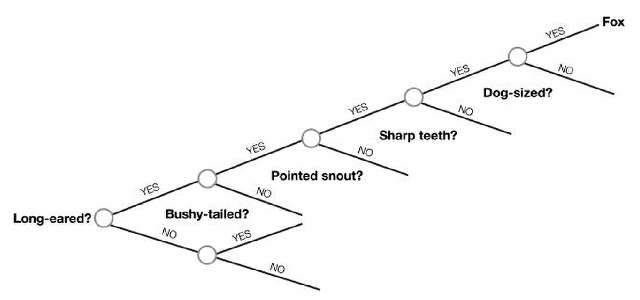
Now for the final step in the design of the mentally choiceful stance: the search engine, as in ‘How did I solve these problems?’ ‘Obviously,’ you will answer yourself, ‘I was using a simple search engine in my mind to go through checklist style, and I was using some rough algorithms that work pretty well in many complex systems.’ What does a search engine do? It searches. And how do you organize an efficient search? Well, algorithm designers tell us you have to have an efficient organization of the contents of whatever it is you are searching. And a tree structure allows you to search more efficiently than most alternative structures.
How a tree structure helps simplify search: A detection algorithm for ‘Fox.’
So what’s Munger’s search algorithm?
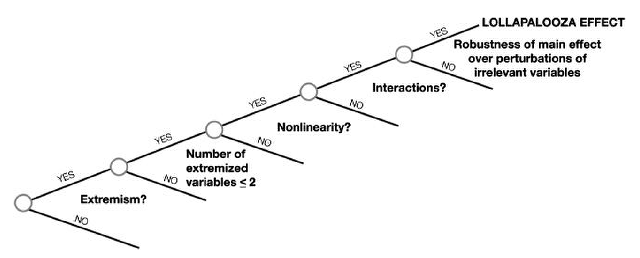
Extreme success is likely to be caused by some combination of the following factors: a) Extreme maximization or minimization of one or two variables. Example[:] Costco, or, [Berkshire Hathaway’s] furniture and appliance store. b) Adding success factors so that a bigger combination drives success, often in nonlinear fashion, as one is reminded of the concept of breakpoint or the concept of critical mass in physics. You get more mass, and you get a lollapalooza result. And of course I’ve been searching for lollapalooza results all my life, so I’m very interested in models that explain their occurrence. [Remember the Black Swan?] c) an extreme of good performance over many factors. Examples: Toyota or Les Schwab. d) Catching and riding some big wave.
Charlie Munger’s lollapalooza detection algorithm, represented as a tree search.
A good search algorithm allows you to make your mental choices clear. It makes it easier for you to be mentally choiceful and to understand the reasons why you’re making these mental choices.
Now, what should go on the branches of your tree of mental models? Well, how about basic mental models from a whole bunch of different disciplines? Such as: physics (non-linearity, criticality), economics (what Munger calls the ‘super-power’ of incentives), the multiplicative effects of several interacting causes (biophysics), and collective phenomena – or ‘catching the wave’ (plasma physics). How’s that for a science that rocks, by placing at the disposal of the mind a large library of forms created by thinkers across hundreds of years and marshalling them for the purpose of detecting, building, and profiting from Black Swans?
The ‘tree trick’ has one more advantage – a big one: it lets you quickly visualize interactions among the various models and identify cumulative effects. Go northwest in your search, starting from the ’0’ node, and the interactions double with every step. Go southwest, on the other hand, and the interactions decrease in number at the same rate. Seen in this rather sketchy way, Black Swan hunting is no longer as daunting a sport as it might seem at first sight.

Tuesday, February 24, 2015

Avoiding Ignorance

Avoiding Ignorance

This is a continuation of two types of ignorance.
You can’t deal with ignorance if you can’t recognize its presence. If you’re suffering from primary ignorance it means you probably failed to consider the possibility of being ignorant or you found ways not to see that you were ignorant.
You’re ignorant and unaware, which is worse than being ignorant and aware.
The best way to avoid this, suggests Joy and Zeckhauser, is to raise self-awareness.
Ask yourself regularly: “Might I be in a state of consequential ignorance here?”
They continue:
If the answer is yes, the next step should be to estimate base rates. That should also be the next step if the starting point is recognized ignorance.
Of all situations such as this, how often has a particular outcome happened. Of course, this is often totally subjective.
and its underpinnings are elusive. It is hard to know what the sample of relevant past experiences has been, how to draw inferences from the experience of others, etc. Nevertheless, it is far better to proceed to an answer, however tenuous, than to simply miss (primary ignorance) or slight (recognized ignorance) the issue. Unfortunately, the assessment of base rates is challenging and substantial biases are likely to enter.
When we don’t recognize ignorance the base rate is extremely underestimated. When we do recognize ignorance, we face “duelling biases; some will lead to underestimates of base rates and others to overestimates.”
Three biases come into play while estimating base rates: overconfidence, salience, and selection biases.
So we are overconfident in our estimates. We estimate things that are salient – that is, “states with which (we) have some experience or that are otherwise easily brought to mind.” And “there is a strong selection bias to recall or retell events that were surprising or of great consequence.”
Our key lesson is that as individuals proceed through life, they should always be on the lookout for ignorance. When they do recognize it, they should try to assess how likely they are to be surprised—in other words, attempt to compute the base rate. In discussing this assessment, we might also employ the term “catchall” from statistics, to cover the outcomes not specifically addressed.
It’s incredibly interesting to view literature through the lens of human decision making.
Crime and Punishment is particularly interesting as a study of primary ignorance. Raskolnikov deploys his impressive intelligence to plan the murder, believing, in his ignorance, that he has left nothing to chance. In a series of descriptions not for the squeamish or the faint-hearted, the murderer’s thoughts are laid bare as he plans the deed. We read about his skills in strategic inference and his powers of prediction about where and how he will corner his victim; his tactics at developing complementary skills (what is the precise manner in which he will carry the axe?; what strategies will help him avoid detection) are revealed.
But since Raskolnikov is making decisions under primary ignorance, his determined rationality is tightly “bounded.” He “construct[s] a simplified model of the real situation in order to deal with it; … behaves rationally with respect to this model, [but] such behavior is not even approximately optimal with respect to the real world” (Simon 1957). The second-guessing, fear, and delirium at the heart of Raskolnikov’s thinking as he struggles to gain a foothold in his inner world show the impact of a cascade of Consequential Amazing Development’s (CAD), none predicted, none even contemplated. Raskolnikov anticipated an outcome in which he would dispatch the pawnbroker and slip quietly out of her apartment. He could not have possibly predicted that her sister would show up, a characteristic CAD that challenges what Taleb (2012) calls our “illusion of predictability.”
Joy and Zeckhauser argue we can draw two conclusions.
First, we tend to downplay the role of unanticipated events, preferring instead to expect simple causal relationships and linear developments. Second, when we do encounter a CAD, we often counter with knee-jerk, impulsive decisions, the equivalent of Raskolnikov committing a second impetuous murder.
Bringing you Farnam Street took thousands of dollars and nearly 1,500 hours in 2013. If you find any value in it, I’d greatly appreciate your support with a modest donation. For extra Karma points, become a member with a monthly donation.
References: Ignorance: Lessons from the Laboratory of Literature (Joy and Zeckhauser).

Two types of ignorance

Two types of ignorance

ignorance
This article builds on Decisions Under Uncertainty. In fact, consider this a continuation.
Think of how we make decisions in organizations — we often do what standard decision theory would ask of us.
We create a powerpoint that identifies the future desired state, identify what might happen, attach weighted probabilities to said outcomes, and make a choice. Perfectly rational. Right?
One of the problems with this approach is the risk charts and matrices that accompany this analysis. In my experience these charts are rarely discussed in detail and become more about checking the ‘I thought about risk’ box than anything else. We conveniently pin things into categories of low, medium, or high risk with a corresponding “impact” scale.
What gets most of the attention is high-risk, high-impact. Perhaps deservedly so. But you have to ask yourself how did we arrive at these arbitrary scales? Is one person’s look at risk the same as someone else’s? Are there hidden incentives to nudge risk one way or another? What biases come into play?
Often we can’t even identify everything. Rarely do people ever go back and look at what happened and how accurate those “risk” tables were. From the ones I’ve seen, the “low risk” stuff happens a lot more often than people imagined. And a lot of things happen that never even made the chart in the first place.
On the occasion when people do go back, and I’ve seen this firsthand, hindsight bias creeps in. “Oh, we discussed that but it didn’t make it in the document. But we knew about it.” Yes, of course you did.
Ignorant and unknowing.
We’re largely ignorant, that is, we operate in a state of the world where some possible outcomes are unknown. However, we’ve prepared for a world where outcomes and probabilities can be estimated. There is a mis-match between our training and reality. You can’t even hope to accurately estimate probabilities if the range of outcomes is unknown.
There are two types of ignorance.
The first category is when we do not know we are ignorant. This is primary ignorance. The second category is when we recognize our ignorance. This is called recognized ignorance.
Empty Suits
Empty Suits and Fragilistas are almost always ignorant and unknowing.
In Antifragile, Nassim Taleb writes:
[The Empty Suit/Fragilista] defaults to thinking that what he doesn’t see is not there, or what he does not understand does not exist. At the core, he tends to mistake the unknown for the nonexistent.
That my friends is primary ignorance. And it’s not limited to empty suits and fragilistas. Consider Anna Karenina:
Primary ignorance ruins the life of one of fiction’s most famous characters, Anna Karenina. Readers of Anna Karenina (1877/2004) know that, in this novel, a train bookends bad news. Anna alights from one train as the novel begins and throws herself under another one as it ends. As she enters the glittering world of pre-Revolutionary Saint Petersburg, Anna catches the eye of the aristocratic bachelor Count Vronsky and quickly falls under his spell. But there is a problem: she is married to the rising politician Karenin, the two have a son Seryozha, and society will not take kindly to the conspicuous adultery of a prominent citizen. Indulging in an extra-marital affair, especially when one’s husband is a respected member of society, promotes the likelihood of unpleasant (events). But her passion for Vronsky dulls Anna’s capacities for self-awareness. She becomes pregnant out of wedlock, a disastrous condition for a woman in nineteenth-century Russia. Anna consistently displays an unfortunate propensity to take action without recognizing that a terrible consequential outcome is possible. That is, she operates in primary ignorance.
Anna demonstrates all the characteristics of primary ignorance. She fails to consider all the possible scenarios that will occur from her impulsive decision making. She risks her marriage with Karenin, a kind if undemonstrative husband, who is willing to forgive and even offers to raise her illegitimate child as his own. Leaving Seryozha with Karenin, she and Vronsky escape to Italy and then to his Russian country estate. Ultimately, she finds that while Vronsky continues to be accepted socially, living his life exactly as he pleases, the door of society slams shut in her face. No one will associate with her and she is insulted as an adulterer wherever she goes. It is only when she is completely isolated socially and cut off from her beloved son that Anna recognizes the dangers of primary ignorance: she risked her family and her reputation for too little. … She realizes she was ignorant of the possible outcomes that jumping headlong into an illicit relationship would bring.
Ignorance, primary or recognized, is only important if the expected consequences are significant. Otherwise we can be ignorant without consequence.
While human irrationality factors into all decisions, it hits us most when we are unknowingly ignorant. Rational decision making becomes harder as we move along the continuum: outcomes are known —> risk —> uncertainty/ignorance.
If we can not consider all possible outcomes, preventing failure becomes nearly impossible. Further complicating matters, situations of ignorance often take years to play out. Joy and Zeckhauser write:
One could argue … that a rational decision maker should always consider the possibility of ignorance, thus ruling out primary ignorance. But that is a level of rationality that very few achieve.
If we could do this we’d always be in the space of recognized ignorance, better, at least, than primary ignorance.
Literature
“Fortunately,” write Joy and Zeckhauser, “there is a group of highly perceptive chroniclers of human decision-making who observe individuals and follow their paths, often over years or decades. They are the individuals who write fiction: plays, novels, and short stories describing imagined events and people (or fictional characters.)”
Joy and Zeckhouser argue these works have “deep insights” into the way we approach decisions, “both great and small.”
In the Poetics, a classical treatise on the principles of literary theory, Aristotle argues that art imitates life. We refer here to Aristotle’s ideas of mimesis, or imitation. Aristotle claims one of art’s functions is the representation of reality. “Art” here includes creative products of the human imagination and, therefore, any work of fiction. Indeed, a crevice, not a canyon, separates faction and fiction.
For centuries, authors have attempted to depict situations of ignorance. In Greek literature, Sophocle’s King Oedipus and Creon, and Homer’s Odysseus all seek forecasting skills of the blind prophet Tiresias who is doomed by Zeus to “speak the truth no man may believe.”
For its status as one of literature’s most enduring love stories, Jane Austen’s Pride and Prejudice begins rather unpromisingly: the hero and the heroine cannot stand each another. The arrogant Mr. Darcy claims Elizabeth Bennet is “not handsome enough to tempt me”; Elizabeth offers the equally withering riposte that she “may safely promise …never to dance with him.” Were we to encounter them after these early skirmishes, we (like Elizabeth and Darcy themselves) would be ignorant of the possibility of an ultimate romance.
In Gustave Flaubert’s Madame Bovary (1856/2004), Charles Bovary is a stolid rural doctor who is ignorant of the true character of the woman he is marrying. Dazzled by her youth and beauty, he ends up with an adulterous wife who plunges him into debt. His wife Emma, the titular “Madame Bovary,” is equally ignorant of the true character of her husband. Her head filled with romantic fantasies, she yearns for a sophisticated partner and the glamor of city life, but finds herself trapped in a somnolent marriage with a rustic man.
K., the land surveyor and protagonist of Franz Kafka’s The Castle, attempts, repeatedly and unsuccessfully, to gain access to the mysterious authorities of a castle but is frustrated by an authoritarian bureaucracy and by ambiguous responses that defy rational interpretation. He begins and ends the novel (as does the reader) in ignorance.
Joy and Zeckhouser use stories to study ignorance, which makes sense.
Stories offer “simulations of the social world,” according to Psychologists Raymond Mar and Keith Oatley, through abstraction, simplification, and compression. Stories afford us a kind of flight simulator. We can test run new things and observe and learn, with little economic or social cost. Joy and Zeckhouser believe “that characters in great works of literature reproduce the behavioral propensities of real-life individuals.”
While we’ll likely never uncover situations as fascinating as we find in stories, this doesn’t mean they are not a useful tool for learning about choice and consequence.
“In a sense,” Joy and Zeckhauser write, “this is why great literature will never get dated: these stories observe the details of human behavior, and present such behavior awash with all the anguish and the splendor that is the lot of the human predicament.
As Steven Pinker notes in How The Mind Works:
Characters in a fictitious world do exactly what our intelligence allows us to do in the real world. We watch what happens to them and mentally take notes on the outcomes of the strategies and tactics they use in pursuing their goals.
If we assume we live in a world where we are, to some extent, ignorant then the best course is “thoughtful action or prudent information gathering.” Yet, when you look at the stories, “we frequently act in ways that violate such advice.”
So reading fiction can help us adapt and deal with the world of uncertainty.
Read part three of this series: Avoiding Ignorance.
References: Ignorance: Lessons from the Laboratory of Literature (Joy and Zeckhauser).

Decisions Under Uncertainty

Decisions Under Uncertainty

risk_uncertainty
We make decisions every day.
For the sake of argument, let’s break them down into a few categories.
There are decisions where:
  1. Outcomes are known. This is the easiest way to make decisions. If I hold out my hand and drop a ball, it will fall to the ground.
  2. Outcomes are unknown, but probabilities are known. This is risk. Think of this as going to Vegas and gambling. Before you set foot at the table, all of the outcomes are known as are the probabilities of each. No outcome surprises an objective third party.
  3. Outcomes are unknown and probabilities are unknown. This is uncertainty.
We often think we’re making decisions in #2 but we’re really in #3.
Ignorance is a state of the world where some possible outcomes are unknown: when we’ve moved from #2 to #3.
One way to realize how ignorant we are is to look back, read some old newspapers, and see how often the world did something that wasn’t even imagined.
Some examples include the Arab Spring, the collapse of the Soviet Union, the financial meltdown.
We’re prepared for a world much like #2 — the world of risk, with known outcomes and probability that can be estimated, yet we live in a world with a closer resemblance to #3.
Read part two of this series: Two types of ignorance.
References: Ignorance: Lessons from the Laboratory of Literature (Joy and Zeckhauser).
Fooled By Randomness

Fooled By Randomness

fooled by randomness
I don’t want you to make the same mistake I did.
I waited too long before reading Fooled by Randomness: The Hidden Role of Chance in Life and in the Markets by Nassim Taleb. He wrote the book before the Black Swan and Antifragile, which propelled him into intellectual celebrity. Interestingly, Fooled by Randomness contains semi-explored gems of the ideas that would later go on to become the best-selling books The Black Swan and Antifragile.
***
Hindsight Bias
Part of the argument that Fooled by Randomness presents is that when we look back at things that have happened we see them as less random than they actually were.
It is as if there were two planets: the one in which we actually live and the one, considerably more deterministic, on which people are convinced we live. It is as simple as that: Past events will always look less random than they were (it is called the hindsight bias). I would listen to someone’s discussion of his own past realizing that much of what he was saying was just backfit explanations concocted ex post by his deluded mind.
***
The Courage of Montaigne
Writing on Montaigne as the role model for the modern thinker, Taleb also addresses his courage:
It certainly takes bravery to remain skeptical; it takes inordinate courage to introspect, to confront oneself, to accept one’s limitations— scientists are seeing more and more evidence that we are specifically designed by mother nature to fool ourselves.
***
Probability
Fooled by Randomness is about probability, not in a mathematical way but as skepticism.
In this book probability is principally a branch of applied skepticism, not an engineering discipline. …
Probability is not a mere computation of odds on the dice or more complicated variants; it is the acceptance of the lack of certainty in our knowledge and the development of methods for dealing with our ignoranceOutside of textbooks and casinos, probability almost never presents itself as a mathematical problem or a brain teaser. Mother nature does not tell you how many holes there are on the roulette table , nor does she deliver problems in a textbook way (in the real world one has to guess the problem more than the solution).
Outside of textbooks and casinos, probability almost never presents itself as a mathematical problem” which is fascinating given how we tend to solve problems. In decisions under uncertainty, I discussed how risk and uncertainty are different things, which creates two types of ignorance.
Most decisions are not risk-based, they are uncertainty-based and you either know you are ignorant or you have no idea you are ignorant. There is a big distinction between the two. Trust me, you’d rather know you are ignorant.
***
Randomness Disguised as Non-Randomness
The core of the book is about luck that we understand as skill or “randomness disguised as non-randomness (that is determinism).”
This problem manifests itself most frequently in the lucky fool, “defined as a person who benefited from a disproportionate share of luck but attributes his success to some other, generally very precise, reason.”
Such confusion crops up in the most unexpected areas, even science, though not in such an accentuated and obvious manner as it does in the world of business. It is endemic in politics, as it can be encountered in the shape of a country’s president discoursing on the jobs that “he” created, “his” recovery, and “his predecessor’s” inflation.
These lucky fools are often fragilistas — they have no idea they are lucky fools. For example:
[W]e often have the mistaken impression that a strategy is an excellent strategy, or an entrepreneur a person endowed with “vision,” or a trader a talented trader, only to realize that 99.9% of their past performance is attributable to chance, and chance alone. Ask a profitable investor to explain the reasons for his success; he will offer some deep and convincing interpretation of the results. Frequently, these delusions are intentional and deserve to bear the name “charlatanism.”
This does not mean that all success is luck or randomness. There is a difference between “it is more random than we think” and “it is all random.”
Let me make it clear here : Of course chance favors the prepared! Hard work, showing up on time, wearing a clean (preferably white) shirt, using deodorant, and some such conventional things contribute to success— they are certainly necessary but may be insufficient as they do not cause success. The same applies to the conventional values of persistence, doggedness and perseverance: necessary, very necessary. One needs to go out and buy a lottery ticket in order to win. Does it mean that the work involved in the trip to the store caused the winning? Of course skills count, but they do count less in highly random environments than they do in dentistry.
No, I am not saying that what your grandmother told you about the value of work ethics is wrong! Furthermore, as most successes are caused by very few “windows of opportunity,” failing to grab one can be deadly for one’s career. Take your luck!
That last paragraph connects to something Charlie Munger once said: Really good investment opportunities aren’t going to come along too often and won’t last too long, so you’ve got to be ready to act. Have a prepared mind.
Taleb thinks of success in terms of degrees, so mild success might be explained by skill and labour but outrageous success “is attributable variance.”
***
Luck Makes You Fragile
One thing Taleb hits on that really stuck with me is that “that which came with the help of luck could be taken away by luck (and often rapidly and unexpectedly at that). The flipside, which deserves to be considered as well (in fact it is even more of our concern), is that things that come with little help from luck are more resistant to randomness.” How Antifragile.
Taleb argues this is the problem of induction, “it does not matter how frequently something succeeds if failure is too costly to bear.”
***
Noise and Signal
We are confused between noise and signal.
…the literary mind can be intentionally prone to the confusion between noise and meaning, that is, between a randomly constructed arrangement and a precisely intended message. However, this causes little harm; few claim that art is a tool of investigation of the Truth— rather than an attempt to escape it or make it more palatable. Symbolism is the child of our inability and unwillingness to accept randomness; we give meaning to all manner of shapes; we detect human figures in inkblots.
All my life I have suffered the conflict between my love of literature and poetry and my profound allergy to most teachers of literature and “critics.” The French thinker and poet Paul Valery was surprised to listen to a commentary of his poems that found meanings that had until then escaped him (of course, it was pointed out to him that these were intended by his subconscious).
If we’re concerned about situations where randomness is confused with non randomness should we also be concerned with situations where non randomness is mistaken for randomness, which would result in signal being ignored?
First, I am not overly worried about the existence of undetected patterns. We have been reading lengthy and complex messages in just about any manifestation of nature that presents jaggedness (such as the palm of a hand, the residues at the bottom of Turkish coffee cups, etc.). Armed with home supercomputers and chained processors, and helped by complexity and “chaos” theories, the scientists, semiscientists, and pseudoscientists will be able to find portents. Second, we need to take into account the costs of mistakes; in my opinion, mistaking the right column for the left one is not as costly as an error in the opposite direction. Even popular opinion warns that bad information is worse than no information at all.
If you haven’t yet, pick up a copy of Fooled by Randomness: The Hidden Role of Chance in Life and in the Markets. Don’t make the same mistake I did and wait to read this important book.

Thursday, January 22, 2015

Frederick W. Taylor: Time Management Skills

Frederick W. Taylor: Time Management Skills

SteelMill_interior
There is no question that the tendency of the average man (in all walks of life) is toward working at a slow, easy gait, and that it is only after a good deal of thought and observation on his part or as a result of example, conscience, or external pressure that he takes a more rapid pace.
***
From Frederick W. Taylor’s 1904 book Shop Management, which appeared long before his Principles of Scientific Management (1911). Taylor is considered the father of management consulting.
The natural laziness of men is serious, but by far the greatest evil from which both workmen and employers are suffering is the systematic soldiering which is almost universal under all of the ordinary schemes of management and which results from a careful study on the part of the workmen of what they think will promote their best interests.
The writer was much interested recently to hear one small but experienced golf caddie boy of twelve explaining to a green caddie who had shown special energy and interest the necessity of going slow and lagging behind his man when he came up to the ball, showing him that since they were paid by the hour, the faster they went, the less money they got, and finally telling him that if he went too fast the other boys would give him a licking.
This represents a type of systematic soldiering which is not, however, very serious, since it is done with the knowledge of the employer, who can quite easily break it up if he wishes.
The greater part of the systematic soldiering, however, is done by the men with the deliberate object of keeping their employers ignorant of how fast work can be done.
So universal is soldiering for this purpose that hardly a competent workman can be found in a large establishment, whether he works by the day or on piecework, contract work or under any of the ordinary systems of compensating labor, who does not devote a considerable part of his time to studying just how slowly he can work and still convince his employer that he is going at a good pace.
The causes for this are, briefly, that practically all employers determine upon a maximum sum which they feel it is right for each of their classes of employees to earn per day, whether their men work by the day or piece.
Each workman soon finds out about what this figure is for his particular case, and he also realizes that when his employer is convinced that a man is capable of doing more work than he has done, he will find sooner or later some way of compelling him to do it with little or no increase of pay.
Employers derive their knowledge of how much of a given class of work can be done in a day from either their own experience, which has frequently grown hazy with age, from casual and unsystematic observation of their men, or at best from records which are kept, showing the quickest time in which each job has been done. In many cases the employer will feel almost certain that a given job can be done faster than it has been, but he rarely cares to take the drastic measures necessary to force men to do it in the quickest time, unless he has an actual record, proving conclusively how fast the work can be done.
It evidently becomes for each man’s interest, then, to see that no job is done faster than it has been in the past. The younger and less experienced men are taught this by their elders, and all possible persuasion and social pressure is brought to bear upon the greedy and selfish men to keep them from making new records which result in temporarily increasing their wages, while all those who come after them are made to work harder for the same old pay.