Tuesday, February 24, 2015

Avoiding Ignorance

Avoiding Ignorance

This is a continuation of two types of ignorance.
You can’t deal with ignorance if you can’t recognize its presence. If you’re suffering from primary ignorance it means you probably failed to consider the possibility of being ignorant or you found ways not to see that you were ignorant.
You’re ignorant and unaware, which is worse than being ignorant and aware.
The best way to avoid this, suggests Joy and Zeckhauser, is to raise self-awareness.
Ask yourself regularly: “Might I be in a state of consequential ignorance here?”
They continue:
If the answer is yes, the next step should be to estimate base rates. That should also be the next step if the starting point is recognized ignorance.
Of all situations such as this, how often has a particular outcome happened. Of course, this is often totally subjective.
and its underpinnings are elusive. It is hard to know what the sample of relevant past experiences has been, how to draw inferences from the experience of others, etc. Nevertheless, it is far better to proceed to an answer, however tenuous, than to simply miss (primary ignorance) or slight (recognized ignorance) the issue. Unfortunately, the assessment of base rates is challenging and substantial biases are likely to enter.
When we don’t recognize ignorance the base rate is extremely underestimated. When we do recognize ignorance, we face “duelling biases; some will lead to underestimates of base rates and others to overestimates.”
Three biases come into play while estimating base rates: overconfidence, salience, and selection biases.
So we are overconfident in our estimates. We estimate things that are salient – that is, “states with which (we) have some experience or that are otherwise easily brought to mind.” And “there is a strong selection bias to recall or retell events that were surprising or of great consequence.”
Our key lesson is that as individuals proceed through life, they should always be on the lookout for ignorance. When they do recognize it, they should try to assess how likely they are to be surprised—in other words, attempt to compute the base rate. In discussing this assessment, we might also employ the term “catchall” from statistics, to cover the outcomes not specifically addressed.
It’s incredibly interesting to view literature through the lens of human decision making.
Crime and Punishment is particularly interesting as a study of primary ignorance. Raskolnikov deploys his impressive intelligence to plan the murder, believing, in his ignorance, that he has left nothing to chance. In a series of descriptions not for the squeamish or the faint-hearted, the murderer’s thoughts are laid bare as he plans the deed. We read about his skills in strategic inference and his powers of prediction about where and how he will corner his victim; his tactics at developing complementary skills (what is the precise manner in which he will carry the axe?; what strategies will help him avoid detection) are revealed.
But since Raskolnikov is making decisions under primary ignorance, his determined rationality is tightly “bounded.” He “construct[s] a simplified model of the real situation in order to deal with it; … behaves rationally with respect to this model, [but] such behavior is not even approximately optimal with respect to the real world” (Simon 1957). The second-guessing, fear, and delirium at the heart of Raskolnikov’s thinking as he struggles to gain a foothold in his inner world show the impact of a cascade of Consequential Amazing Development’s (CAD), none predicted, none even contemplated. Raskolnikov anticipated an outcome in which he would dispatch the pawnbroker and slip quietly out of her apartment. He could not have possibly predicted that her sister would show up, a characteristic CAD that challenges what Taleb (2012) calls our “illusion of predictability.”
Joy and Zeckhauser argue we can draw two conclusions.
First, we tend to downplay the role of unanticipated events, preferring instead to expect simple causal relationships and linear developments. Second, when we do encounter a CAD, we often counter with knee-jerk, impulsive decisions, the equivalent of Raskolnikov committing a second impetuous murder.
Bringing you Farnam Street took thousands of dollars and nearly 1,500 hours in 2013. If you find any value in it, I’d greatly appreciate your support with a modest donation. For extra Karma points, become a member with a monthly donation.
References: Ignorance: Lessons from the Laboratory of Literature (Joy and Zeckhauser).

Two types of ignorance

Two types of ignorance

ignorance
This article builds on Decisions Under Uncertainty. In fact, consider this a continuation.
Think of how we make decisions in organizations — we often do what standard decision theory would ask of us.
We create a powerpoint that identifies the future desired state, identify what might happen, attach weighted probabilities to said outcomes, and make a choice. Perfectly rational. Right?
One of the problems with this approach is the risk charts and matrices that accompany this analysis. In my experience these charts are rarely discussed in detail and become more about checking the ‘I thought about risk’ box than anything else. We conveniently pin things into categories of low, medium, or high risk with a corresponding “impact” scale.
What gets most of the attention is high-risk, high-impact. Perhaps deservedly so. But you have to ask yourself how did we arrive at these arbitrary scales? Is one person’s look at risk the same as someone else’s? Are there hidden incentives to nudge risk one way or another? What biases come into play?
Often we can’t even identify everything. Rarely do people ever go back and look at what happened and how accurate those “risk” tables were. From the ones I’ve seen, the “low risk” stuff happens a lot more often than people imagined. And a lot of things happen that never even made the chart in the first place.
On the occasion when people do go back, and I’ve seen this firsthand, hindsight bias creeps in. “Oh, we discussed that but it didn’t make it in the document. But we knew about it.” Yes, of course you did.
Ignorant and unknowing.
We’re largely ignorant, that is, we operate in a state of the world where some possible outcomes are unknown. However, we’ve prepared for a world where outcomes and probabilities can be estimated. There is a mis-match between our training and reality. You can’t even hope to accurately estimate probabilities if the range of outcomes is unknown.
There are two types of ignorance.
The first category is when we do not know we are ignorant. This is primary ignorance. The second category is when we recognize our ignorance. This is called recognized ignorance.
Empty Suits
Empty Suits and Fragilistas are almost always ignorant and unknowing.
In Antifragile, Nassim Taleb writes:
[The Empty Suit/Fragilista] defaults to thinking that what he doesn’t see is not there, or what he does not understand does not exist. At the core, he tends to mistake the unknown for the nonexistent.
That my friends is primary ignorance. And it’s not limited to empty suits and fragilistas. Consider Anna Karenina:
Primary ignorance ruins the life of one of fiction’s most famous characters, Anna Karenina. Readers of Anna Karenina (1877/2004) know that, in this novel, a train bookends bad news. Anna alights from one train as the novel begins and throws herself under another one as it ends. As she enters the glittering world of pre-Revolutionary Saint Petersburg, Anna catches the eye of the aristocratic bachelor Count Vronsky and quickly falls under his spell. But there is a problem: she is married to the rising politician Karenin, the two have a son Seryozha, and society will not take kindly to the conspicuous adultery of a prominent citizen. Indulging in an extra-marital affair, especially when one’s husband is a respected member of society, promotes the likelihood of unpleasant (events). But her passion for Vronsky dulls Anna’s capacities for self-awareness. She becomes pregnant out of wedlock, a disastrous condition for a woman in nineteenth-century Russia. Anna consistently displays an unfortunate propensity to take action without recognizing that a terrible consequential outcome is possible. That is, she operates in primary ignorance.
Anna demonstrates all the characteristics of primary ignorance. She fails to consider all the possible scenarios that will occur from her impulsive decision making. She risks her marriage with Karenin, a kind if undemonstrative husband, who is willing to forgive and even offers to raise her illegitimate child as his own. Leaving Seryozha with Karenin, she and Vronsky escape to Italy and then to his Russian country estate. Ultimately, she finds that while Vronsky continues to be accepted socially, living his life exactly as he pleases, the door of society slams shut in her face. No one will associate with her and she is insulted as an adulterer wherever she goes. It is only when she is completely isolated socially and cut off from her beloved son that Anna recognizes the dangers of primary ignorance: she risked her family and her reputation for too little. … She realizes she was ignorant of the possible outcomes that jumping headlong into an illicit relationship would bring.
Ignorance, primary or recognized, is only important if the expected consequences are significant. Otherwise we can be ignorant without consequence.
While human irrationality factors into all decisions, it hits us most when we are unknowingly ignorant. Rational decision making becomes harder as we move along the continuum: outcomes are known —> risk —> uncertainty/ignorance.
If we can not consider all possible outcomes, preventing failure becomes nearly impossible. Further complicating matters, situations of ignorance often take years to play out. Joy and Zeckhauser write:
One could argue … that a rational decision maker should always consider the possibility of ignorance, thus ruling out primary ignorance. But that is a level of rationality that very few achieve.
If we could do this we’d always be in the space of recognized ignorance, better, at least, than primary ignorance.
Literature
“Fortunately,” write Joy and Zeckhauser, “there is a group of highly perceptive chroniclers of human decision-making who observe individuals and follow their paths, often over years or decades. They are the individuals who write fiction: plays, novels, and short stories describing imagined events and people (or fictional characters.)”
Joy and Zeckhouser argue these works have “deep insights” into the way we approach decisions, “both great and small.”
In the Poetics, a classical treatise on the principles of literary theory, Aristotle argues that art imitates life. We refer here to Aristotle’s ideas of mimesis, or imitation. Aristotle claims one of art’s functions is the representation of reality. “Art” here includes creative products of the human imagination and, therefore, any work of fiction. Indeed, a crevice, not a canyon, separates faction and fiction.
For centuries, authors have attempted to depict situations of ignorance. In Greek literature, Sophocle’s King Oedipus and Creon, and Homer’s Odysseus all seek forecasting skills of the blind prophet Tiresias who is doomed by Zeus to “speak the truth no man may believe.”
For its status as one of literature’s most enduring love stories, Jane Austen’s Pride and Prejudice begins rather unpromisingly: the hero and the heroine cannot stand each another. The arrogant Mr. Darcy claims Elizabeth Bennet is “not handsome enough to tempt me”; Elizabeth offers the equally withering riposte that she “may safely promise …never to dance with him.” Were we to encounter them after these early skirmishes, we (like Elizabeth and Darcy themselves) would be ignorant of the possibility of an ultimate romance.
In Gustave Flaubert’s Madame Bovary (1856/2004), Charles Bovary is a stolid rural doctor who is ignorant of the true character of the woman he is marrying. Dazzled by her youth and beauty, he ends up with an adulterous wife who plunges him into debt. His wife Emma, the titular “Madame Bovary,” is equally ignorant of the true character of her husband. Her head filled with romantic fantasies, she yearns for a sophisticated partner and the glamor of city life, but finds herself trapped in a somnolent marriage with a rustic man.
K., the land surveyor and protagonist of Franz Kafka’s The Castle, attempts, repeatedly and unsuccessfully, to gain access to the mysterious authorities of a castle but is frustrated by an authoritarian bureaucracy and by ambiguous responses that defy rational interpretation. He begins and ends the novel (as does the reader) in ignorance.
Joy and Zeckhouser use stories to study ignorance, which makes sense.
Stories offer “simulations of the social world,” according to Psychologists Raymond Mar and Keith Oatley, through abstraction, simplification, and compression. Stories afford us a kind of flight simulator. We can test run new things and observe and learn, with little economic or social cost. Joy and Zeckhouser believe “that characters in great works of literature reproduce the behavioral propensities of real-life individuals.”
While we’ll likely never uncover situations as fascinating as we find in stories, this doesn’t mean they are not a useful tool for learning about choice and consequence.
“In a sense,” Joy and Zeckhauser write, “this is why great literature will never get dated: these stories observe the details of human behavior, and present such behavior awash with all the anguish and the splendor that is the lot of the human predicament.
As Steven Pinker notes in How The Mind Works:
Characters in a fictitious world do exactly what our intelligence allows us to do in the real world. We watch what happens to them and mentally take notes on the outcomes of the strategies and tactics they use in pursuing their goals.
If we assume we live in a world where we are, to some extent, ignorant then the best course is “thoughtful action or prudent information gathering.” Yet, when you look at the stories, “we frequently act in ways that violate such advice.”
So reading fiction can help us adapt and deal with the world of uncertainty.
Read part three of this series: Avoiding Ignorance.
References: Ignorance: Lessons from the Laboratory of Literature (Joy and Zeckhauser).

Decisions Under Uncertainty

Decisions Under Uncertainty

risk_uncertainty
We make decisions every day.
For the sake of argument, let’s break them down into a few categories.
There are decisions where:
  1. Outcomes are known. This is the easiest way to make decisions. If I hold out my hand and drop a ball, it will fall to the ground.
  2. Outcomes are unknown, but probabilities are known. This is risk. Think of this as going to Vegas and gambling. Before you set foot at the table, all of the outcomes are known as are the probabilities of each. No outcome surprises an objective third party.
  3. Outcomes are unknown and probabilities are unknown. This is uncertainty.
We often think we’re making decisions in #2 but we’re really in #3.
Ignorance is a state of the world where some possible outcomes are unknown: when we’ve moved from #2 to #3.
One way to realize how ignorant we are is to look back, read some old newspapers, and see how often the world did something that wasn’t even imagined.
Some examples include the Arab Spring, the collapse of the Soviet Union, the financial meltdown.
We’re prepared for a world much like #2 — the world of risk, with known outcomes and probability that can be estimated, yet we live in a world with a closer resemblance to #3.
Read part two of this series: Two types of ignorance.
References: Ignorance: Lessons from the Laboratory of Literature (Joy and Zeckhauser).

Fooled By Randomness

Fooled By Randomness

fooled by randomness
I don’t want you to make the same mistake I did.
I waited too long before reading Fooled by Randomness: The Hidden Role of Chance in Life and in the Markets by Nassim Taleb. He wrote the book before the Black Swan and Antifragile, which propelled him into intellectual celebrity. Interestingly, Fooled by Randomness contains semi-explored gems of the ideas that would later go on to become the best-selling books The Black Swan and Antifragile.
***
Hindsight Bias
Part of the argument that Fooled by Randomness presents is that when we look back at things that have happened we see them as less random than they actually were.
It is as if there were two planets: the one in which we actually live and the one, considerably more deterministic, on which people are convinced we live. It is as simple as that: Past events will always look less random than they were (it is called the hindsight bias). I would listen to someone’s discussion of his own past realizing that much of what he was saying was just backfit explanations concocted ex post by his deluded mind.
***
The Courage of Montaigne
Writing on Montaigne as the role model for the modern thinker, Taleb also addresses his courage:
It certainly takes bravery to remain skeptical; it takes inordinate courage to introspect, to confront oneself, to accept one’s limitations— scientists are seeing more and more evidence that we are specifically designed by mother nature to fool ourselves.
***
Probability
Fooled by Randomness is about probability, not in a mathematical way but as skepticism.
In this book probability is principally a branch of applied skepticism, not an engineering discipline. …
Probability is not a mere computation of odds on the dice or more complicated variants; it is the acceptance of the lack of certainty in our knowledge and the development of methods for dealing with our ignorance. Outside of textbooks and casinos, probability almost never presents itself as a mathematical problem or a brain teaser. Mother nature does not tell you how many holes there are on the roulette table , nor does she deliver problems in a textbook way (in the real world one has to guess the problem more than the solution).
“Outside of textbooks and casinos, probability almost never presents itself as a mathematical problem” which is fascinating given how we tend to solve problems. In decisions under uncertainty, I discussed how risk and uncertainty are different things, which creates two types of ignorance.
Most decisions are not risk-based, they are uncertainty-based and you either know you are ignorant or you have no idea you are ignorant. There is a big distinction between the two. Trust me, you’d rather know you are ignorant.
***
Randomness Disguised as Non-Randomness
The core of the book is about luck that we understand as skill or “randomness disguised as non-randomness (that is determinism).”
This problem manifests itself most frequently in the lucky fool, “defined as a person who benefited from a disproportionate share of luck but attributes his success to some other, generally very precise, reason.”
Such confusion crops up in the most unexpected areas, even science, though not in such an accentuated and obvious manner as it does in the world of business. It is endemic in politics, as it can be encountered in the shape of a country’s president discoursing on the jobs that “he” created, “his” recovery, and “his predecessor’s” inflation.
These lucky fools are often fragilistas — they have no idea they are lucky fools. For example:
[W]e often have the mistaken impression that a strategy is an excellent strategy, or an entrepreneur a person endowed with “vision,” or a trader a talented trader, only to realize that 99.9% of their past performance is attributable to chance, and chance alone. Ask a profitable investor to explain the reasons for his success; he will offer some deep and convincing interpretation of the results. Frequently, these delusions are intentional and deserve to bear the name “charlatanism.”
This does not mean that all success is luck or randomness. There is a difference between “it is more random than we think” and “it is all random.”
Let me make it clear here : Of course chance favors the prepared! Hard work, showing up on time, wearing a clean (preferably white) shirt, using deodorant, and some such conventional things contribute to success— they are certainly necessary but may be insufficient as they do not cause success. The same applies to the conventional values of persistence, doggedness and perseverance: necessary, very necessary. One needs to go out and buy a lottery ticket in order to win. Does it mean that the work involved in the trip to the store caused the winning? Of course skills count, but they do count less in highly random environments than they do in dentistry.
No, I am not saying that what your grandmother told you about the value of work ethics is wrong! Furthermore, as most successes are caused by very few “windows of opportunity,” failing to grab one can be deadly for one’s career. Take your luck!
That last paragraph connects to something Charlie Munger once said: “Really good investment opportunities aren’t going to come along too often and won’t last too long, so you’ve got to be ready to act. Have a prepared mind.”
Taleb thinks of success in terms of degrees, so mild success might be explained by skill and labour but outrageous success “is attributable variance.”
***
Luck Makes You Fragile
One thing Taleb hits on that really stuck with me is that “that which came with the help of luck could be taken away by luck (and often rapidly and unexpectedly at that). The flipside, which deserves to be considered as well (in fact it is even more of our concern), is that things that come with little help from luck are more resistant to randomness.” How Antifragile.
Taleb argues this is the problem of induction, “it does not matter how frequently something succeeds if failure is too costly to bear.”
***
Noise and Signal
We are confused between noise and signal.
…the literary mind can be intentionally prone to the confusion between noise and meaning, that is, between a randomly constructed arrangement and a precisely intended message. However, this causes little harm; few claim that art is a tool of investigation of the Truth— rather than an attempt to escape it or make it more palatable. Symbolism is the child of our inability and unwillingness to accept randomness; we give meaning to all manner of shapes; we detect human figures in inkblots.
…
All my life I have suffered the conflict between my love of literature and poetry and my profound allergy to most teachers of literature and “critics.” The French thinker and poet Paul Valery was surprised to listen to a commentary of his poems that found meanings that had until then escaped him (of course, it was pointed out to him that these were intended by his subconscious).
If we’re concerned about situations where randomness is confused with non randomness should we also be concerned with situations where non randomness is mistaken for randomness, which would result in signal being ignored?
First, I am not overly worried about the existence of undetected patterns. We have been reading lengthy and complex messages in just about any manifestation of nature that presents jaggedness (such as the palm of a hand, the residues at the bottom of Turkish coffee cups, etc.). Armed with home supercomputers and chained processors, and helped by complexity and “chaos” theories, the scientists, semiscientists, and pseudoscientists will be able to find portents. Second, we need to take into account the costs of mistakes; in my opinion, mistaking the right column for the left one is not as costly as an error in the opposite direction. Even popular opinion warns that bad information is worse than no information at all.
If you haven’t yet, pick up a copy of Fooled by Randomness: The Hidden Role of Chance in Life and in the Markets. Don’t make the same mistake I did and wait to read this important book.

Thursday, January 22, 2015

Frederick W. Taylor: Time Management Skills

Frederick W. Taylor: Time Management Skills

SteelMill_interior
“There is no question that the tendency of the average man (in all walks of life) is toward working at a slow, easy gait, and that it is only after a good deal of thought and observation on his part or as a result of example, conscience, or external pressure that he takes a more rapid pace.“
***
From Frederick W. Taylor’s 1904 book Shop Management, which appeared long before his Principles of Scientific Management (1911). Taylor is considered the father of management consulting.
The natural laziness of men is serious, but by far the greatest evil from which both workmen and employers are suffering is the systematic soldiering which is almost universal under all of the ordinary schemes of management and which results from a careful study on the part of the workmen of what they think will promote their best interests.
The writer was much interested recently to hear one small but experienced golf caddie boy of twelve explaining to a green caddie who had shown special energy and interest the necessity of going slow and lagging behind his man when he came up to the ball, showing him that since they were paid by the hour, the faster they went, the less money they got, and finally telling him that if he went too fast the other boys would give him a licking.
This represents a type of systematic soldiering which is not, however, very serious, since it is done with the knowledge of the employer, who can quite easily break it up if he wishes.
The greater part of the systematic soldiering, however, is done by the men with the deliberate object of keeping their employers ignorant of how fast work can be done.
So universal is soldiering for this purpose that hardly a competent workman can be found in a large establishment, whether he works by the day or on piecework, contract work or under any of the ordinary systems of compensating labor, who does not devote a considerable part of his time to studying just how slowly he can work and still convince his employer that he is going at a good pace.
The causes for this are, briefly, that practically all employers determine upon a maximum sum which they feel it is right for each of their classes of employees to earn per day, whether their men work by the day or piece.
Each workman soon finds out about what this figure is for his particular case, and he also realizes that when his employer is convinced that a man is capable of doing more work than he has done, he will find sooner or later some way of compelling him to do it with little or no increase of pay.
Employers derive their knowledge of how much of a given class of work can be done in a day from either their own experience, which has frequently grown hazy with age, from casual and unsystematic observation of their men, or at best from records which are kept, showing the quickest time in which each job has been done. In many cases the employer will feel almost certain that a given job can be done faster than it has been, but he rarely cares to take the drastic measures necessary to force men to do it in the quickest time, unless he has an actual record, proving conclusively how fast the work can be done.
It evidently becomes for each man’s interest, then, to see that no job is done faster than it has been in the past. The younger and less experienced men are taught this by their elders, and all possible persuasion and social pressure is brought to bear upon the greedy and selfish men to keep them from making new records which result in temporarily increasing their wages, while all those who come after them are made to work harder for the same old pay.

Remember Not to Trust Your Memory

Remember Not to Trust Your Memory

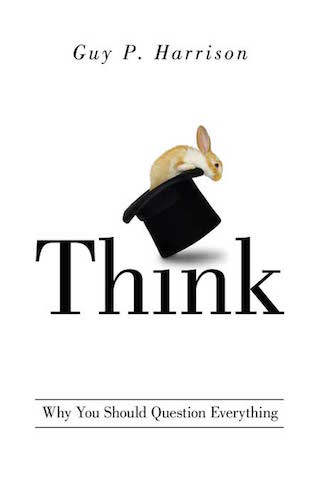
think
Memories are the stories that we tell ourselves about the past. Sometimes they adjust and leave things out.
In an interesting passage in Think: Why You Should Question Everything, Guy P. Harrison talks about the fallibility of memory.
Did you know that you can’t trust even your most precious memories?
They may come to you in great detail and feel 100 percent accurate, but it doesn’t matter. They easily could be partial or total lies that your brain is telling you. Really, the personal past that your brain is supposed to be keeping safe for you is not what you think it is. Your memories are pieces and batches of information that your brain cobbles together and serves up to you, not to present the past as accurately as possible, but to provide you with information that you will likely find to be useful in the present. Functional value, not accuracy, is the priority. Your brain is like some power-crazed CIA desk jockey who feeds you memories on a need-to-know basis only. Daniel Schacter, a Harvard memory researcher, says that when the brain remembers, it does so in a way that is similar to how an archaeologist reconstructs a past scene relying on an artifact here, an artifact there. The end result might be informative and useful, but don’t expect it to be perfect. This is important because those who don’t know anything about how memory works already have one foot in fantasyland. Most people believe that our memory operates in a way that is similar to a video camera. They think that the sights, sounds, and feelings of our experiences are recorded on something like a hard drive in their heads. Totally wrong. When you remember your past, you don’t get to watch an accurately recorded replay.
To describe to people how memory really works, Harrison puts it this way:
Imagine a very tiny old man sitting by a very tiny campfire somewhere inside your head. He’s wearing a worn and raggedy hat and has a long, scruffy, gray beard. He looks a lot like one of those old California gold prospectors from the 1800s. He can be grumpy and uncooperative at times, but he’s the keeper of your memories and you are stuck with him. When you want or need to remember something from your past, you have to go through the old codger. Let’s say you want to recall that time when you scored the winning goal in a middle-school soccer match. You have to tap the old coot on the shoulder and ask him to tell you about it. He usually responds with something. But he doesn’t read from a faithfully recorded transcript, doesn’t review a comprehensive photo archive to create an accurate timeline, and doesn’t double-check his facts before speaking. He definitely doesn’t play a video recording of the game for you. Typically, he just launches into a tale about your glorious goal that won the big game. He throws up some images for you, so it’s kind of like a lecture or slideshow. Nice and useful, perhaps, but definitely not reliable

Friday, January 16, 2015

How To Think

How To Think

Farnam Street Newsletter
I wrote a response on quora recently to the question ‘how do I become a better thinker’ that generated a lot of attention and feedback so I thought I’d build on that a little and post it here too.
***
Thinking is not IQ. When people talk about thinking they make the mistake of thinking that people with high IQs think better. That’s not what I’m talking about. I hate to break it to you but unless you’re trying to get into Mensa, IQ tests don’t matter as much as we think they do. After a certain point, that’s not the type of knowledge or brainpower that makes you better at life, happier, or more successful. It’s a measure sure, but a relatively useless one.
If you want to outsmart people who are smarter than you, temperament and life-long learning are more important than IQ.
Two of the guiding principles that I follow on my path towards seeking wisdom are: (1) Go to bed smarter than when you woke up; and (2) I’m not smart enough to figure everything out myself, so I want to ‘master the best of what other people have already figured out.’
Acquiring wisdom, is hard. Learning how to think is hard. It means sifting through information, filtering the bunk, and connecting it to a framework that you can use. A lot of people want to get their opinions from someone else. I know this because whenever anyone blurts out an opinion and I ask why, I get some hastily re-phrased sound-byte that doesn’t contextualize the problem, identify the forces at play, demonstrate differences or similarities with previous situations, consider base rates, or … anything else that would demonstrate some level of thinking. (One of my favorite questions to probe thinking is to ask what information would cause someone to change their mind. Immediately stop listening and leave if they say ‘I can’t think of anything.’)
Thinking is hard work. I get it. You don’t have time to think but that doesn’t mean you get a pass from me. I want to think for myself, thank you.
***
So one effective thing you can do if you want to think better is to become better at probing other people’s thinking. Ask questions. Simple ones are better. “Why” is the best. If you ask that three or four times you get to a place where you’re going to understand more and you’ll be able to tell who really knows what they are talking about. Shortcuts in thinking are easy, and this is how you tease them out. Not to make the other person look bad – don’t do this maliciously – but to avoid mistakes, air assumptions, and discuss conclusions.
Another thing you can do is to slow down. Make sure you give yourself time to think. I know, it’s a fast-paced internet world where we get some cultural machoism points for answering on the spot but unless it has to be decided at that very moment, simply say “let me think about that for a bit and get back to you.” The world will not end while you think about it.
You should also probe yourself. Try and understand if you’re talking about something you really know something about or if you’re just regurgitating some talking head you heard on the news last night. Your life will become instantly better and your mind clearer if you simply stop the latter. You’re only fooling yourself and if you don’t understand the limits of what you know, you’re going to get in trouble.
***
Learning how to think really means continuously learning.
How can we do that?
First we need a framework to put things on so we can remember, integrate, and make them available for use.
Acquiring knowledge may seem like a daunting task. There is so much to know and time is precious. Luckily, we don’t have to master everything. To get the biggest bang for the buck we can study the big ideas from physics, biology, psychology, philosophy, literature, and sociology.
Our aim is not to remember facts and try to repeat them when asked. We’re going to try and hang these ideas on a latticework of mental models. Doing this puts them in a useable form and enables us to make better decisions.
A mental model is simply a representation of an external reality inside your head. Mental models are concerned with understanding knowledge about the world.
Decisions are more likely to be correct when ideas from multiple disciplines all point towards the same conclusion.
It’s like the old saying, “To the man with only a hammer, every problem looks like a nail.” Let’s make every attempt not to be the man with only a hammer.
Charlie Munger further elaborates:
And the models have to come from multiple disciplines because all the wisdom of the world is not to be found in one little academic department. That’s why poetry professors, by and large, are so unwise in a worldly sense. They don’t have enough models in their heads. So you’ve got to have models across a fair array of disciplines.
You may say, “My God, this is already getting way too tough.” But, fortunately, it isn’t that tough because 80 or 90 important models will carry about 90% of the freight in making you a worldly wise person. And, of those, only a mere handful really carry very heavy freight.
These models generally fall into two categories: (1) ones that help us simulate time (and predict the future) and better understand how the world works (e.g. understanding a useful idea from like autocatalysis), and (2) ones that help us better understand how our mental processes lead us astray (e.g., availability bias).
When our mental models line up with reality they help us avoid problems. However, they also cause problems when they don’t line up with reality as we think something that isn’t true. So Beware.
In Peter Bevelin’s masterful book Seeking Wisdom, he highlights Munger talking about autocatalysis:
If you get a certain kind of process going in chemistry, it speeds up on its own. So you get this marvellous boost in what you’re trying to do that runs on and on. Now, the laws of physics are such that it doesn’t run on forever. But it runs on for a goodly while. So you get a huge boost. You accomplish A – and, all of a sudden, you’re getting A + B + C for awhile.
But knowing is not enough. You need to know how to apply this to other problems outside of the domain in which you learned it.
Munger continues:
Disney is an amazing example of autocatalysis … They had those movies in the can. They owned the copyright. And just as Coke could prosper when refrigeration came, when the videocassette was invented, Disney didn’t have to invent anything or do anything except take the thing out of the can and stick it on the cassette.
***
What models do we need?
I keep a running list that I’m filling in over time, but really how we store and sort these are individual preferences. The framework is not a one-stop-shop, it’s how it fits into your brain.
How can we acquire these models?
There are several ways to acquire the models, the first and probably best source is reading. Even Warren Buffett says reading is one of the best ways to get wiser.
But sadly if your goal is wisdom acquisition, you can’t just pick up a book and read it. You need to Learn How To Read A Book all over again. Most people look at my reading habits (What I’m Reading) and think that I speed read. I don’t. I think that’s a bunch of hot air. If you think you can pick up a book on a subject you’re unfamiliar with and in 30 minutes become an expert … well, good luck to you. Please go back to getting your opinions from twitter.
Focus on the big, simple ideas.
Focus on deeply understanding the simple ideas (see Five Elements of Effective Thinking). These simple ideas, not the cutting-edge ones are the ones you want to hang on your latticework. The latticework is important because it makes the knowledge useable – you not only recall but you internalize.
But the world is always changing … what should we learn first?
One of the biggest mistakes I see people making is to try and learn the cutting-edge research first. The way we prioritize learning has huge implications beyond the day-to-day. When we chase the latest thing, we’re really jumping into an arms race (see: The Red Queen Effect). We have to spend more and more of our time and energy to stay in the same place.
Despite our intentions, learning in this way fails to take advantage of cumulative knowledge. We’re not adding, we’re only maintaining.
If we are to prioritize learning, we should focus on ideas that change slowly – these tend to be the ones from the hard sciences. (see Adding Mental Models to Your Toolbox)
The models that come from hard science and engineering are the most reliable models on this Earth. And engineering quality control – at least the guts of it that matters to you and me and people who are not professional engineers – is very much based on the elementary mathematics of Fermat and Pascal: It costs so much and you get so much less likelihood of it breaking if you spend this much… And, of course, the engineering idea of a backup system is a very powerful idea. The engineering idea of breakpoints – that’s a very powerful model, too. The notion of a critical mass – that comes out of physics – is a very powerful model.
To help further prioritize learning
Knowledge has a half-life. The most useful knowledge is a broad-based multidisciplinary education of the basics. These ideas are ones that have lasted, and thus will last, for a long time. And by last, I mean mathematical expectation; I know what will happen in general but not each individual case.
Integrating Knowledge
Our world is mutli-dimensional and our problems are complicated. Most problems cannot be solved using one model alone. The more models we have the better able we are to rationally solve problems. But if we don’t have the models we become the proverbial man with a hammer.
To the man with a hammer everything looks like a nail. If you only have one model you will fit whatever problem you face to the model you have. If you have more than one model, however, you can look at the problem from a variety of perspectives and increase the odds you come to a better solution.
No one discipline has all the answers, only by looking at them all can we come to grow worldly wisdom.
Charles Munger illustrates the importance of this:
Suppose you want to be good at declarer play in contract bridge. Well, you know the contract – you know what you have to achieve. And you can count up the sure winners you have by laying down your high cards and your invincible trumps.
But if you’re a trick or two short, how are you going to get the other needed tricks? Well, there are only six or so different, standard methods: You’ve got long-suit establishment. You’ve got finesses. You’ve got throw-in plays.
You’ve got cross-ruffs. You’ve got squeezes. And you’ve got various ways of misleading the defense into making errors. So it’s a very limited number of models. But if you only know one or two of those models, then you’re going to be a horse’s patoot in declarer play…
If you don’t have the full repertoire, I guarantee you that you’ll over-utilize the limited repertoire you have – including use of models that are inappropriate just because they’re available to you in the limited stock you have in mind.
As for how we can use different ideas, Munger again shows the way …
Have a full kit of tools … go through them in your mind checklist-style. … [Y]ou can never make any explanation that can be made in a more fundamental way in any other way than the most fundamental way.
When you combine things you get lollapalooza effects — the integration of more than one effect to create a non-linear response.
A two-step process for making effective decisions
There is no point in being wiser unless you use it for good. You know, as Aunt May put it to Peter Parker, “with great power comes great responsibility.”
Personally, I’ve gotten so that I now use a kind of two-track analysis. First, what are the factors that really govern the interests involved, rationally considered? And second, what are the subconscious influences where the brain at a subconscious level is automatically doing these things-which by and large are useful, but which often misfunction.
One approach is rationality-the way you’d work out a bridge problem: by evaluating the real interests, the real probabilities and so forth. And the other is to evaluate the psychological factors that cause subconscious conclusions-many of which are wrong.
This is the path, the rest is up to you.